By: James Pardee
Moore’s Law

Born in California during 1929 Gordan Moore is most famously known for his Moore’s Law, as well as co-founding /Intel. In his younger years he studied chemistry at the University of California, Berkeley, and went on to receive a PhD in chemistry and physics from California Institute of Technology. In 1965 Moore predicted several developments in computer chip technology such as steady doubling in transistors over the next decade. This predication became known as Moore’s Law. As the number of components per chip would increase, the smaller the chips would become, the faster and more efficient technology would turn out to be, therefor making Moore’s Law turn into a reality. Certain aspects of his theory that I found interesting is that while many doubts the contingency of his prediction it has been yet to be incorrect. Every year computers get smaller and become more powerful adding to the exponential increase of Moore’s Law.
Fuller’s Theory
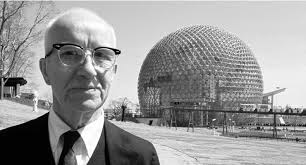
Richard Buckminster Fuller could possible be one of the greatest minds of our time, developing pioneer solutions that showed the revolutionary technological design that would make more with less, improving the environment and people’s lives. Born in Massachusetts on 1895, Buckminster grasped nature early in which he would incorporate much of the Earth’s nature in his experiments and innovations. Never graduating college, Fuller joined the Navy, where he then went on to become architect and manufacturer. Fuller is well known for using technology to revolutionize human activities and housing. His most famous innovation includes the Dymaxion car, Dymaxion House, and the Geodesic dome. All lightweight, cost effective, and easy to assemble modifications for human life. Fuller believed that resources were limited, which is why he used as little resources as possible because even though our knowledge is limitless our resources are not. Buckminster Fuller also created the Knowledge Doubling Curve, where he believed that while knowledge is growing and expanding it widens at different rates of growth so not everything is on the same playing field. This can go hand to hand with Peter Thiel as he complains about only the accelerated rate of growth in computers while other areas are further behind in their rate of growth. Being a social thinker, Fuller thought that we have failed to advance the quality of life along with all our technological advancements. An aspect of Fuller that I found interesting is that he is evidence to his own theory. As time went on he brought much to the people, growing the amount of information we seem to know.
Kurzweil’s Law
Ray Kurzweil is an acclaimed entrepreneur, inventor, and futurist. Born in 1948, Kurzweil started science young. Graduating for MIT with a degree in computer science and literature he went on to develop optical character recognition, text to speech synthesis, speech recognition technology, and electronic keyboard instruments while establishing Kurzweil Computer Products. He is also well known for predicting technological advancements over the past twenty-five years behind his law of accelerating returns. Kurzweil’s Law of Accelerating Returns is like Moore’s Law in how they both show the notion of increasing technological evolution; however, Kurzweil goes further than just a computer chip. Kurzweil’s Law focuses on the common force driving technological progress forward. Kurzweil often compares the evolution of technology to biology as each technology can only stem for its predecessor, and with time the technology grows exponentially, increasing in speed, efficiency, price performance, and overall power. As technologies evolve and add to themselves, we will only see progress rates continue to double by the decade instead of increasing at a steady rate. An aspect of Kurzweil’s Law that I found interesting is his ability to come close to predicting future technologies. For example, he predicted that a computer would beat a world class chess player by the 1998, then the year before that very thing happened. It takes a mad man to predict that men would loose to a computer, especially in the 90’s, but he knew the course technology was taking.
Thiel’s Theory
Born in West German during 1967, Peter Thiel is an entrepreneur and business executive who help create PayPal and Palantir Technologies. Studying philosophy at Stanford University, Thiel then attended and graduated Stanford Law School where he published articles on political correctness. Thiel also attends talk shows where he also believes that while computers and technology have proven to evolve there has not been enough futuristic growth in other areas such as energy, transportation, space travel, health, or even underwater cities as we would see in the movies. Thiel criticizes the lack of innovation entrepreneurs have in today’s society, as he describes it as: “We wanted flying cars, instead we got 140 characters.” In his End of the Future Theory he states that technological progress is starting to slow down, as we are running out of ideas. He goes to explain how all these companies like Google and Apple have all this money but don’t have the knowledge to invest it into growing technologies such as biotechnology, aerospace, and advanced machines. So just as their money wastes away into yesterday as does our futurama. Even with the huge acceleration in computers and internet, Thiel explains we have been in an era of stagnation which has given no thought to the future. One thing I found very surprising is that even though Thiel is this big entrepreneur you would think he would only want the next money-making innovation however he pushed for ambition and spunk.
 James Pardee's Blog